
Lajos Rácz: The Solution to the Water Crisis Is the Antidote to the Decline of Our Civilization

Just as “water regulation” was the focus of the Reform Era, “water retention” must be the focus of our time, according to environmental historian Lajos Rácz. In an article sent to Válasz Online, the professor at the University of Szeged explains that, just as in the 1830s and 1840s, Hungarian society is currently under significant ecological pressure, which poses a risk not of rapid collapse but rather of slow decline. One of the main remedies is deep-floodplain water recharge in the Great Hungarian Plain, but “in terms of scale and significance, this would likely rival the 19th-century railway construction projects.”

Rácz Lajos korábban magyarul megjelent írásának angol nyelvű fordítása
This text, in which I attempt to reflect on what can be done about the consequences of contemporary climate change for Hungary’s landscape and society, was inspired by Barna Borbás’s article titled “This Heat Wave Is the Final Warning,” published on Válasz Online (in Hungarian). The example from climate history cited in the introduction to Barna’s article was the “Year Without a Summer” of 1816, which triggered the last traditional subsistence crisis in European history. If we interpret this example as a climatic anomaly that triggered the crisis, the parallel is justified. Yet it is hard to ignore that in 1816, a cold and rainy summer ruined the harvest; today, however, heat and drought cause similar consequences year after year.
My colleague, meteorologist Mónika Lakatos, and I have been working for a year and a half on a monograph tentatively titled The Climate History of Hungary—and we’ve already missed three submission deadlines. I set the manuscript aside and looked into whether Hungarian history had ever seen a prolonged drought similar to today’s. Of course, any parallel is imperfect, and one cannot ignore the social conditions of the time or the changing nature of economic networks, but I did find an interesting similarity. This was the 19th-century Reform Era (1825–1848), during which—over the course of a little more than two decades—we know of seven particularly dry summers: 1830, 1834, 1836, 1839, 1841, 1842, and 1846. Moreover, the weather in the other seasons was not particularly stable either. During the Reform Era, there were four winters when the Danube remained frozen for more than 60 days: 1830, 1836, 1838, and 1841. Two years remain particularly memorable: the winter of 1830, when the river remained “frozen through” at Pest-Buda for 99 days, and 1838, when the ice flood swept away most of Pest. In other words,
contemporary Hungarian society was under significant ecological pressure in the 1830s and the 1840s as well.
It is worth examining these ecological crises from the perspective of environmental history.
History is the extended memory of human communities, and environmental history—which emerged in the second half of the 20th century—has recognized the natural environment as an active participant in history, using the historical ecosystem as its analytical framework. Climate history—a branch of environmental history—helps assess what can be expected in the Carpathian Basin during a prolonged period of drought.
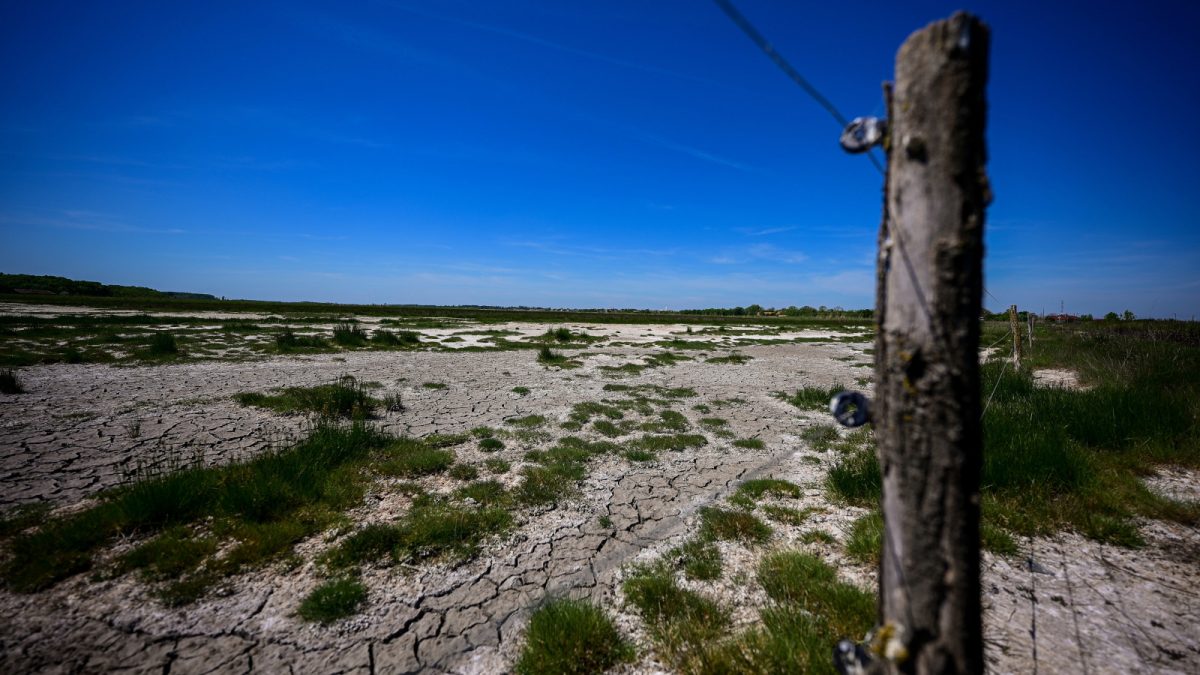
The droughts of the Reform Era were not episodes lasting just a few weeks, but periods—mostly very hot and persistently dry—that lasted from late spring or early summer through the fall. Important indicators of the severity of the drought included soil desiccation, dust storms, and soil cracks. Spring crops, root crops, meadows, and pastures were the most vulnerable to summer drought. In many cases, the feed shortage escalated into a livestock crisis. Drought thus posed a direct threat to food security. The heat and water shortages made daily life difficult and also hindered the operation of infrastructure. It is no coincidence that “regulating” the natural environment was a constant topic of public discourse.
At the same time, Hungarian society during the Reform Era had some important ecological advantages compared to the situation today, at least as far as summer droughts are concerned. For one thing, during the Little Ice Age—a climatic period extending from the 14th century to the turn of the 20th century—winters and the winter half of the year became significantly colder. Summers did not become significantly cooler, but precipitation increased throughout the year; a good indicator of this is the water level of Lake Balaton, which was one to one and a half meters higher than it is today.
We are referring to the early period of river regulation, when we know that the Tisza Valley still included an estimated 23,000–25,000 km2 of water-covered land; the river flowed slowly, at approximately half its current speed; there was no need to worry about the riverbed deepening; and the conditions for floodwater infiltration were also favorable. All of this took place within a unified political territory, which in the 19th century was not yet referred to as the Carpathian Basin, but rather as the Middle Danube Basin or simply the Danube Valley, in which all watercourses—with the exception of the Poprad and the Dunajec—belonged to the Danube river system.
Today, however, we are living through an accelerating phase of modern-era global warming. If, like Barna, we accept the climate history analysis of Christian Pfister and Heinz Wanner, then
since 1988 we have had to adapt to a climate unlike any we have ever experienced before, because the radical increase in oil consumption has driven
the Earth’s climate past a tipping point.
In theatrical terms: a door closed, and it wasn’t until more than a decade and a half later that we realized there was no doorknob. Moreover, as a result of political developments in the twentieth century, drought management—and, ultimately, control over water resources—became an issue of international law and politics in the Danube Valley. Consider, for example, the Slovak-Hungarian conflict that arose over the Bős/Gabčíkovo-Nagymaros hydroelectric power plant, or the Romanian-Hungarian conflict triggered by the cyanide disaster that struck the Tisza river system.
There are, therefore, two eras: the Reform Era and contemporary Hungary after the political transition; in both periods, significant ecological pressures have weighed on society and the political system. The key concept in the land-use strategy of Reform Era modernization was water regulation; today, it is water retention. At the same time, it is important to note that the climate and its changes obviously do not “make” history on their own; rather—to use historian John Brooke’s interesting analogy—they are like the slope of the stage in a theater: it doesn’t write the play, but it determines which direction is easiest to move in and where objects roll on their own.
In practice, 19th-century water management involved regulating rivers to reduce the risk of flooding, improve transportation conditions, and increase arable land. Strong political interests and lobby groups were behind all three of these objectives.
The most devastating floods of the 19th century struck major cities such as Pest-Buda in 1838 and Szeged in 1879. These events drew nationwide—and in some cases international—attention and affected citizens with voting rights, thereby spurring decision-makers to act.
The railroad network was built in the second half of the 19th century, and it revitalized the Hungarian economy of the time with astonishing force. The significance of the railroad—and, of course, the worldview of decision-makers—is well illustrated by the fact that when, during a drier period between 1859 and 1861, the South Balaton Railroad was built lower than necessary, the embankments were not later rebuilt; instead, the water level of Lake Balaton was adjusted to match the height of the embankment.
The third key factor was the expansion of arable land, driven in part by the growth of the country’s population in the 19th century and in part by the pull of the Monarchy’s protected domestic market. The class of large landowners that emerged in the 18th century as a result of river regulation projects—and particularly the landowners in the Tisza Valley—had a vested interest in these projects. As we know from Zsolt Pinke’s research, the project was not feasible on a market basis, since
the cost of water management was significantly higher than the increase in value that could be achieved in this way. Consequently, state subsidies had to be obtained,
which, for the sake of simplicity, we can refer to as area-based support. In the end, water regulation projects were carried out wherever possible—and even in areas where they should not have been.
When developing a future land-use strategy, we need hardly take into account either the dynamic growth of the country’s population or the large-scale construction of new rail lines. Thus, from the 19th-century structure of interests, essentially only one group remains on the scene when it comes to rethinking landscape use on a large scale: agricultural producers, particularly those farming on large estates. The predominance of large estates is a long-standing and enduring feature of the Hungarian landholding structure; land concentration is even more pronounced today than it was in 1935.
There is broad consensus among climate researchers and ecologists that climate change will primarily affect the areas east of the Danube, with the large Danube alluvial fans—the Homokhátság and the Nyírség—being the hardest hit. In these areas, we must expect a steppe climate in the short term.
To prevent the situation from getting any worse, water must be directed to the deep floodplain areas during periods of high water to improve conditions for water infiltration into the soil. In this way, we must reintegrate the rivers into the landscape.
We are talking about hundreds of thousands of hectares of privately owned land that offers relatively good growing conditions even during periods of drought—land that its owners are unlikely to voluntarily give up for the common good. A project like this can only succeed if it is backed by a clear government commitment, a funding framework, and a legal framework. At the same time, in order to reach an appropriate compromise, all affected landowners and professional communities—organized on a regional basis where applicable—must participate in the consultation process. Given the scale and significance of the undertaking, this would likely rival the 19th-century railway construction projects.
The Earth’s climate is warming, and Europe is particularly affected by this process—especially the Carpathian-Balkan region. These conditions will most likely remain with us in the coming years. The door that closed in 1988 will not open again. At the same time, I do not believe in the collapse of civilization, but I do believe in a slow decline. Things will always get just a little worse—but permanently. We can get used to this, but perhaps there is also something we can do about it.
Featured image: Dry, cracked soil near Balmazújváros, Hungary (source: MTI/Zsolt Czeglédi)